
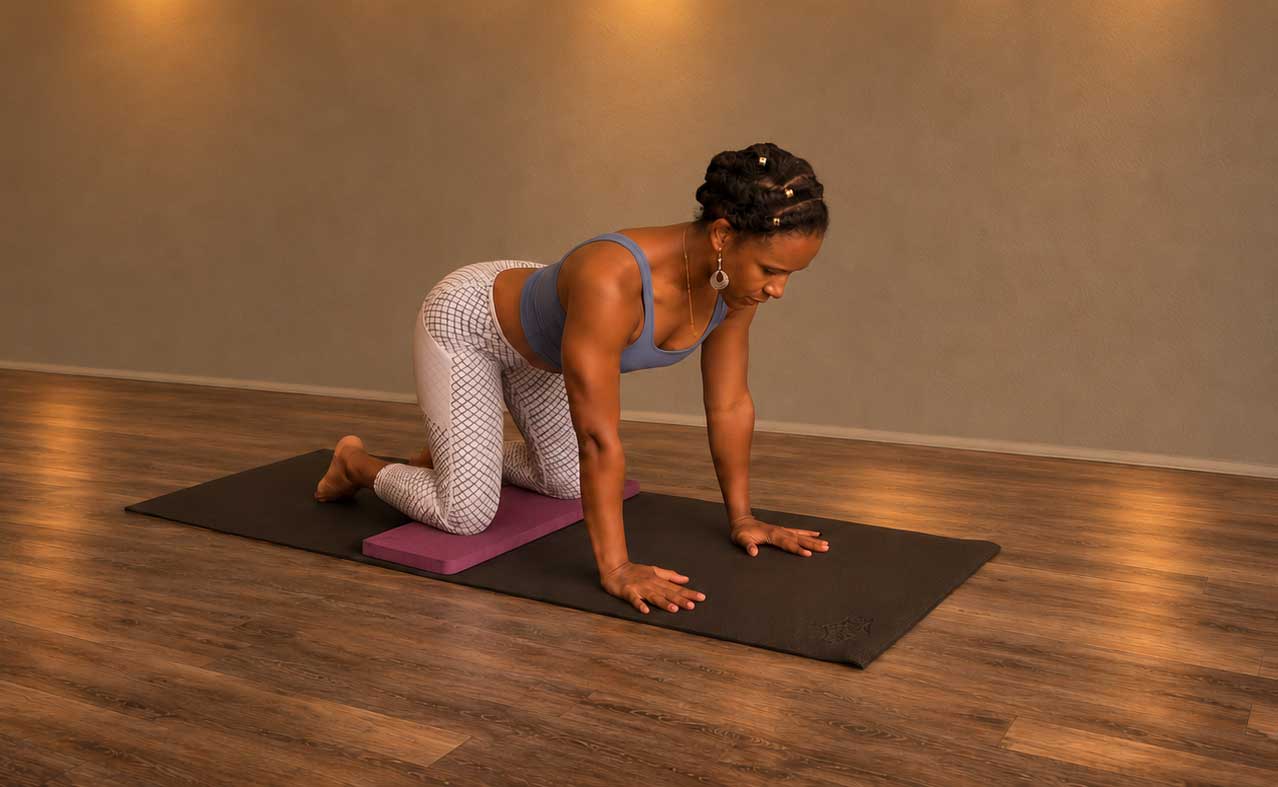
The good news is that you don’t have to give up yoga because your knees need a little extra attention. There are plenty of ways to adjust your practice so you can keep moving, building strength, and enjoying your time on the mat.
And you don’t need to do every pose exactly the way the person next to you is doing it.
First, Pay Attention to What Your Knees Are Telling You
There’s a difference between feeling your muscles working and feeling pain in a joint.
A little muscular effort is normal during yoga. Sharp pain, pinching, catching, or a feeling that your knee might give out is not something to push through.
If a pose bothers your knee, come out of it and try a different position. Sometimes a small adjustment is all you need. Other times, skipping that particular pose is the better choice.
If you’re dealing with a recent injury, significant swelling, or ongoing knee pain, it’s worth checking with a qualified healthcare professional before continuing your practice.
Give Your Knees Some Cushion
One of the easiest modifications is also one of the most effective: put something soft underneath your knee.
Poses like Tabletop, Low Lunge, and Gate Pose place your knee directly against the floor. Even with a good yoga mat, that pressure can be uncomfortable.
Try folding a blanket or placing a small cushion under your knee. A dedicated yoga knee pad works well, too, especially if you prefer something that doesn’t take up much room on your mat.
Just make sure the padding is stable and doesn’t slide around.
Remember that cushioning helps with pressure against the floor. It won’t necessarily help if the discomfort comes from bending or twisting the knee itself.
Make Your Lunges a Little Easier
Lunges are common in yoga, but they can be challenging when your knees are sensitive.
In a Low Lunge, try placing a folded blanket under your back knee and keeping your hands on blocks for support. You can also shorten the distance between your feet so you’re not stretching quite as deeply.
For a standing lunge, you don’t have to bend your front knee as far as possible. A smaller bend may feel much better.
Pay attention to the direction your knee is moving. Generally, it’s helpful to have your knee follow the direction of your toes rather than allowing it to collapse inward.
If lunges consistently cause pain, try a gentler standing pose instead.
Warrior Poses Don’t Have to Be Deep
Warrior I and Warrior II are wonderful poses for developing strength and stability, but there’s no rule that says your front thigh has to be parallel to the floor.
Try shortening your stance and bending your front knee less.
In Warrior II, check that your front knee is moving in the same general direction as your front toes. You can also straighten your front leg a little if holding a deep bend becomes uncomfortable.
For Warrior I, adjusting the width of your stance or lifting your back heel may help you find a more comfortable position.
The goal isn’t to make the pose look a certain way. It’s to find a position where you can breathe comfortably and feel your muscles working without irritating your knees.
Child’s Pose Isn’t Comfortable for Everyone
Child’s Pose is often offered as a resting position, but for some people, bending the knees deeply can be uncomfortable.
If that’s you, try placing a folded blanket between your thighs and calves to reduce how far your knees bend. You can also keep your hips higher rather than sitting all the way back toward your heels.
If that still doesn’t feel good, skip Child’s Pose.
A comfortable seated position, lying on your back, or resting in another position can accomplish the same thing: giving yourself a moment to relax.
There’s nothing especially restful about a pose that hurts.
Use Blocks to Take Some Pressure Off
Yoga blocks are useful for much more than helping you reach the floor.
In poses like Triangle or Half Moon, blocks can provide support so you don’t have to reach as far or struggle to maintain your balance.
They can also be helpful in standing poses when you’re working on stability.
For someone with sensitive knees, having that extra support can make it easier to move slowly and maintain control.
Don’t think of blocks as something you use until you’re flexible enough to stop needing them. They’re tools that can make your practice more comfortable and enjoyable, regardless of your experience.
Be Careful With Deep Knee Bends and Twisting
Some poses combine a deep bend in the knee with rotation at the hip. Pigeon Pose, Lotus Pose, and certain seated positions are examples.
These positions aren’t necessarily a problem for everyone, but they can be uncomfortable for people with knee issues, especially when the hip doesn’t move easily into the position.
Avoid pulling your foot or knee into place to make the pose look deeper.
If Pigeon Pose bothers your knee, try a Figure Four stretch while lying on your back. You can adjust the position of your legs and control how much stretch you feel.
If sitting cross legged is uncomfortable, sit on a folded blanket, extend your legs, or use a chair.
Your knees don’t need to be forced into a position just because it’s part of the class.
Don’t Forget About Strength and Stability
When we talk about protecting our knees, it’s easy to focus entirely on stretching and flexibility.
But strength matters, too.
The muscles around your hips, thighs, and lower legs all contribute to how you move and support your knees.
Gentle, controlled movements such as supported Chair Pose, Bridge Pose, and balancing with a hand on the wall may help build strength and stability when they’re comfortable for you.
Start with a small range of motion and gradually build from there.
You don’t need to hold a difficult pose for a long time to benefit from it. Sometimes a few controlled movements are more useful than one long hold.
If you’re attending a group class, mention your knee concerns to your teacher before class begins.
You don’t need to share your entire medical history. Simply saying, “My knees have been bothering me, so I may need some modifications,” is enough to start the conversation.
Your teacher may be able to suggest props, alternate positions, or ways to reduce the intensity of certain poses.
And if you need to skip something, that’s perfectly fine.
At SukhaLife Yoga, we want students to feel comfortable making choices that work for their bodies. Some days that means taking a stronger variation. Other days it means using a chair, grabbing an extra blanket, or resting for a few minutes.
All of those choices belong in a yoga practice.
A Few Things Worth Remembering
You don’t have to bend your knees deeply to get something out of a pose. You don’t have to sit on your heels if that hurts. And you certainly don’t have to keep up with everyone else in the room.
Use props when they’re helpful. Move slowly enough to notice how you feel. Give yourself permission to change a pose or leave it out entirely.
Most importantly, don’t treat knee pain as something you need to overcome through determination.
Yoga should give you opportunities to move, breathe, and feel better in your body. With a few thoughtful adjustments, sensitive knees don’t have to keep you from enjoying your practice.
Practicing with us in St. Petersburg? Let your teacher know if you need a little extra support. We’re always happy to help you find a comfortable way to participate.


